

Cookware / surface decisions
Titanium Cookware Surface Finish Options
A buyer-focused guide to evaluating natural, brushed, matte and polished titanium cookware surface finishes.
Direct answer
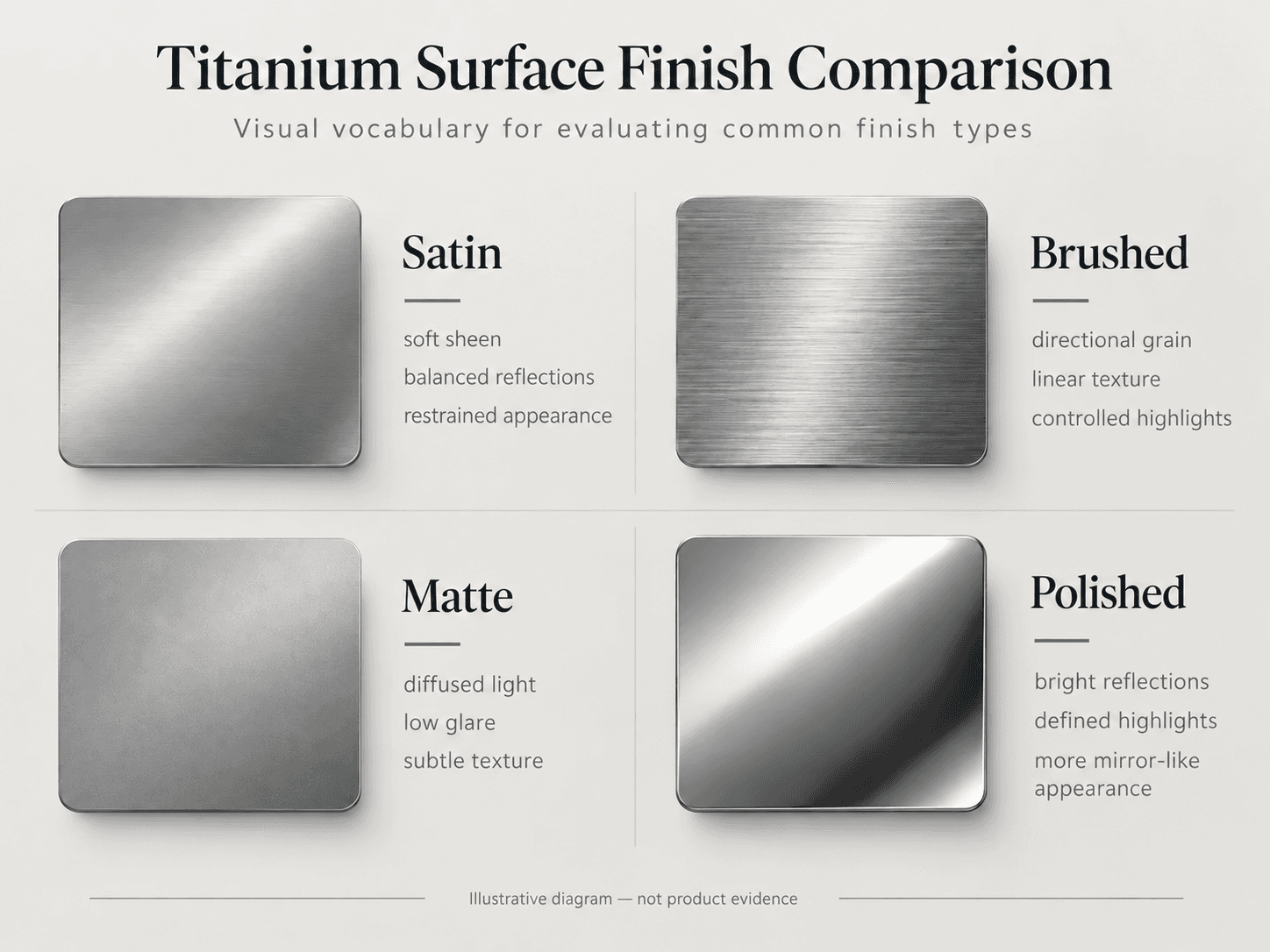
Surface finish changes how a titanium cookware product looks and how visual wear, fingerprints and branding are perceived. The right finish should be selected against the product geometry, intended use, cleaning expectations, marking method and an approved physical sample—not from a generic superiority claim.
Key takeaways
- Finish is an appearance and manufacturing decision, not proof of scratch resistance or food-contact compliance.
- Brushed, matte/blasted and polished surfaces can create different visual responses to handling and light.
- Coatings must be evaluated separately from bare-titanium surface treatment.
- A physical sample is the appropriate approval point for finish consistency.
Separate surface appearance from product claims
Use precise terms when reviewing a surface. A surface finish describes the resulting visible condition; a surface treatment describes a process used to create or alter that condition; a coating is an added layer. Brushing, matte or blasted finishes and polishing can create different visual responses to handling and light. These descriptions concern appearance; they do not establish durability, safety, scratch resistance or a particular material grade.
If a product includes a coating, polymer component or multi-material construction, treat that component as a separate specification and documentation question. Do not transfer claims from a base-metal finish to a coated finished article.
Finish review checklist
Use the same lighting and handling conditions when comparing samples. Ask whether the finish is intended for exterior surfaces, interior surfaces or both, and identify areas affected by forming, joining, laser marking or assembly.
| Finish direction | What it changes visually | What to review |
|---|---|---|
| Natural / satin | Restrained metal appearance | Texture consistency, forming marks and sample-to-sample variation. |
| Brushed | Directional grain and controlled reflection | Brush direction, transitions around joins and marking placement. |
| Matte / blasted | Lower-gloss appearance | Coverage, edge treatment and how the intended product is handled. |
| Polished | Higher reflectivity | Reflection control, visual defects and the agreed sample standard. |
How to approve a finish
Specify the intended visual target, product areas, sample reference, acceptable variation, marking method and inspection approach. A written finish description plus approved sample reduces ambiguity more effectively than broad terms such as ‘premium’ or ‘scratch-proof’.
7Titanium’s public product visuals—including AI-generated illustrative visuals—do not prove a finish specification. Confirm the final finish with the selected product configuration and sample.
Questions buyers often ask
Does a brushed finish make titanium scratch-proof?
No. A brushed appearance is not a warranty or performance claim; evaluate wear against the intended product and sample.
Can one finish be specified for every product surface?
Not automatically. Geometry, joining, use and visual requirements may differ between areas.
Does a product visual confirm the finish?
No. A visual supports discussion of an intended appearance; an approved physical sample defines the final target.
Scope and evidence boundary
This article is educational. Product-specific material, finish, documentation, testing and compliance statements must be verified against the selected configuration and applicable market requirements.
References
- ATI CP Grade 1, CP Grade 2, CP Grade 3, CP Grade 4 Technical Data SheetATI · Commercially pure titanium grades, ductility, strength and fabrication context.
Have a configuration to review?
Share the product brief, target market and documentation question for a project-specific conversation.
Start your project