
Documentation / food-contact review
How to Evaluate Titanium Food-Contact Documentation
A practical checklist for reviewing product-specific food-contact documentation without relying on vague compliance badges.
Direct answer
Food-contact documentation should be assessed against the actual finished product, its components, intended food use and target market. A generic supplier statement or a broad ‘FDA’, ‘LFGB’ or ‘REACH’ label is not equivalent to product-specific evidence with a defined scope, issuer, standard and date.
Key takeaways
- Start with the finished article and its intended use, not a generic badge.
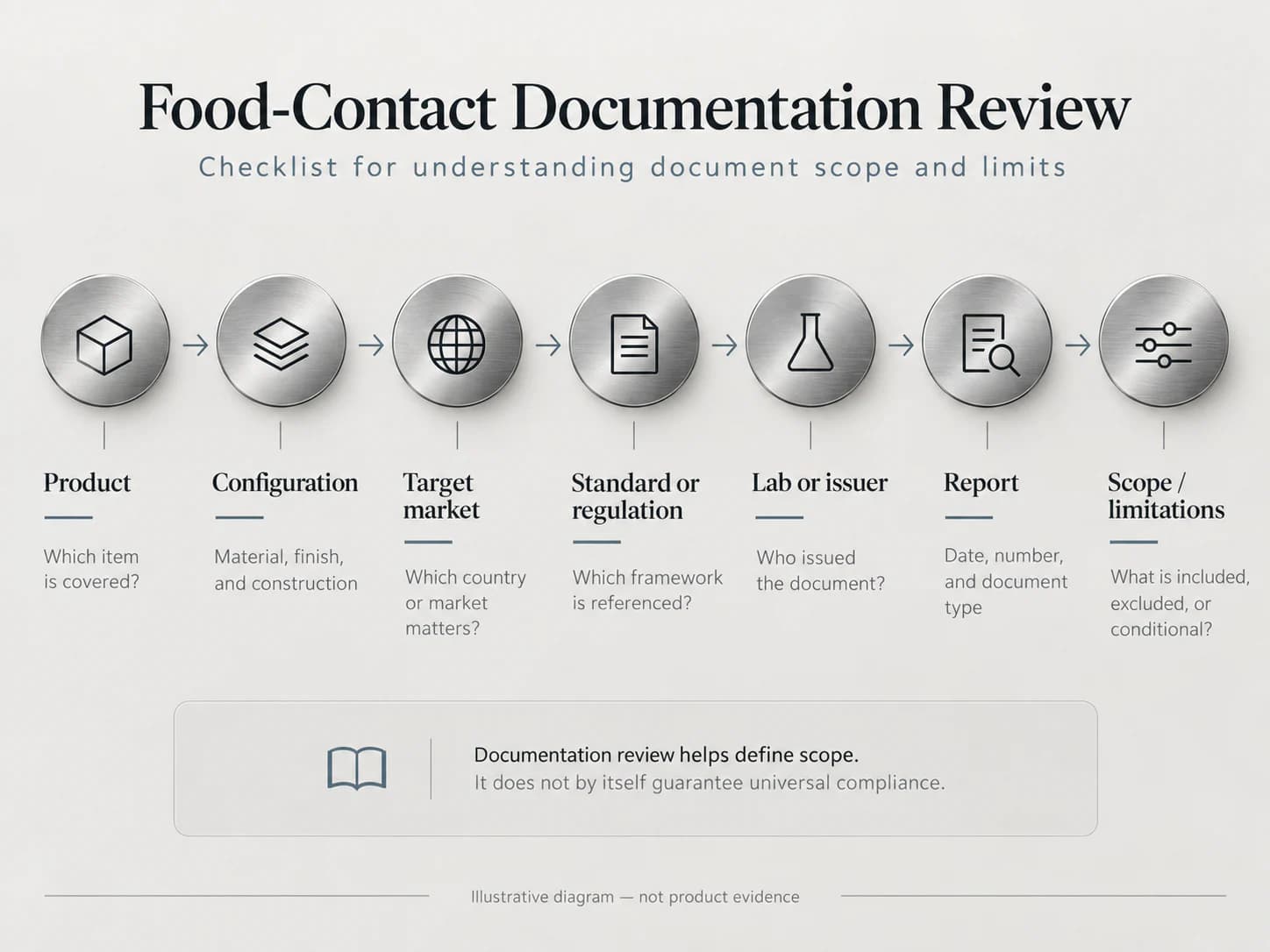
- Check the tested specimen, material/configuration, target market, report issuer, standard, report number and report date.
- Food type and conditions of use can matter to a regulatory assessment.
- 7Titanium has no public brand-wide food-contact, FDA, LFGB or REACH claim in the claim registry.
What a buyer should identify first
Identify the finished article, every material and component in the food-contact path, the target market, the intended food types and the conditions of use. FDA explains that authorizations for food-contact substances are tied to the relevant substance and intended-use context; its food-type and conditions-of-use references show why generic labels can be incomplete.
In the EU, Regulation (EC) No 1935/2004 provides a framework for materials and articles intended to contact food. It does not turn a product name or an unscoped supplier statement into product-specific proof.
Source basis: FDA food-contact guidance and Food Types & Conditions of Use; Regulation (EC) No 1935/2004 (see References).
Documentation checklist
Request the underlying report or traceable documentation rather than relying on a marketing summary. Verify that the document applies to the product configuration being purchased, including relevant finish, coating, lid, seal, component and intended market.
| Check | Why it matters | Evidence to request |
|---|---|---|
| Tested article | A report must match the relevant finished configuration | Product description, specimen identification and component scope. |
| Market and intended use | Regulatory context is jurisdiction and use dependent | Target market, food type and conditions-of-use scope. |
| Issuer and method | A document needs traceable provenance | Laboratory/issuer, standard or method, report number and date. |
| Current configuration | A change can affect relevance | Revision, material/finish/assembly details and change history. |
| Report scope and limits | A report has stated boundaries | Applicable standard, exclusions, conditions and conclusion. |
Keep regulatory terms separate
FDA, LFGB and REACH are not interchangeable labels. FDA food-contact context concerns U.S. regulatory pathways and intended use. LFGB is German legislation that includes consumer articles, while BfR food-contact recommendations are non-binding, material-specific recommendations rather than product authorizations. REACH is an EU chemicals framework and should not be used as a blanket food-contact badge. Ask the responsible reviewer to identify the applicable requirement for the actual market and product.
This is an educational checklist, not legal advice or a claim that a 7Titanium product is compliant, certified or tested.
Source basis: BfR food-contact materials explanation; see References. Regulatory applicability requires product- and market-specific review.
Questions buyers often ask
Is an FDA statement the same as a food-contact test report?
No. Their scope and legal meaning may differ; review the actual document, intended use and product configuration.
Can a supplier declaration replace a report?
It can be useful context, but it is not automatically equivalent to traceable product-specific test documentation.
Do FDA, LFGB and REACH mean the same thing?
No. They refer to different regulatory or testing contexts and should be evaluated separately.
Scope and evidence boundary
This article is educational. Product-specific material, finish, documentation, testing and compliance statements must be verified against the selected configuration and applicable market requirements.
References
- Understanding How the FDA Regulates Substances that Come into Contact with FoodU.S. Food and Drug Administration · Scope and intended-use context for food-contact substances.
- Food Types & Conditions of Use for Food Contact SubstancesU.S. Food and Drug Administration · Examples of food categories and use conditions used in FDA food-contact notification context.
- Regulation (EC) No 1935/2004 on materials and articles intended to come into contact with foodEUR-Lex · EU framework for food-contact materials and articles.
- Detailed explanation: BfR recommendations on food contact materialsGerman Federal Institute for Risk Assessment (BfR) · Explains food-contact materials, BfR recommendations and their non-binding legal status.
Have a configuration to review?
Share the product brief, target market and documentation question for a project-specific conversation.
Start your project