

Materials / commercially pure titanium
Titanium Grade 1 vs Grade 2 for Consumer Products
A practical, evidence-aware comparison of commercially pure Grade 1 and Grade 2 titanium for consumer-product evaluation.
Direct answer
In practical terms, commercially pure Grade 1 is generally selected where greater formability is useful, while Grade 2 offers higher strength. Neither is universally better: product geometry, forming route, joining, finish, service environment and the final material specification determine the appropriate choice.
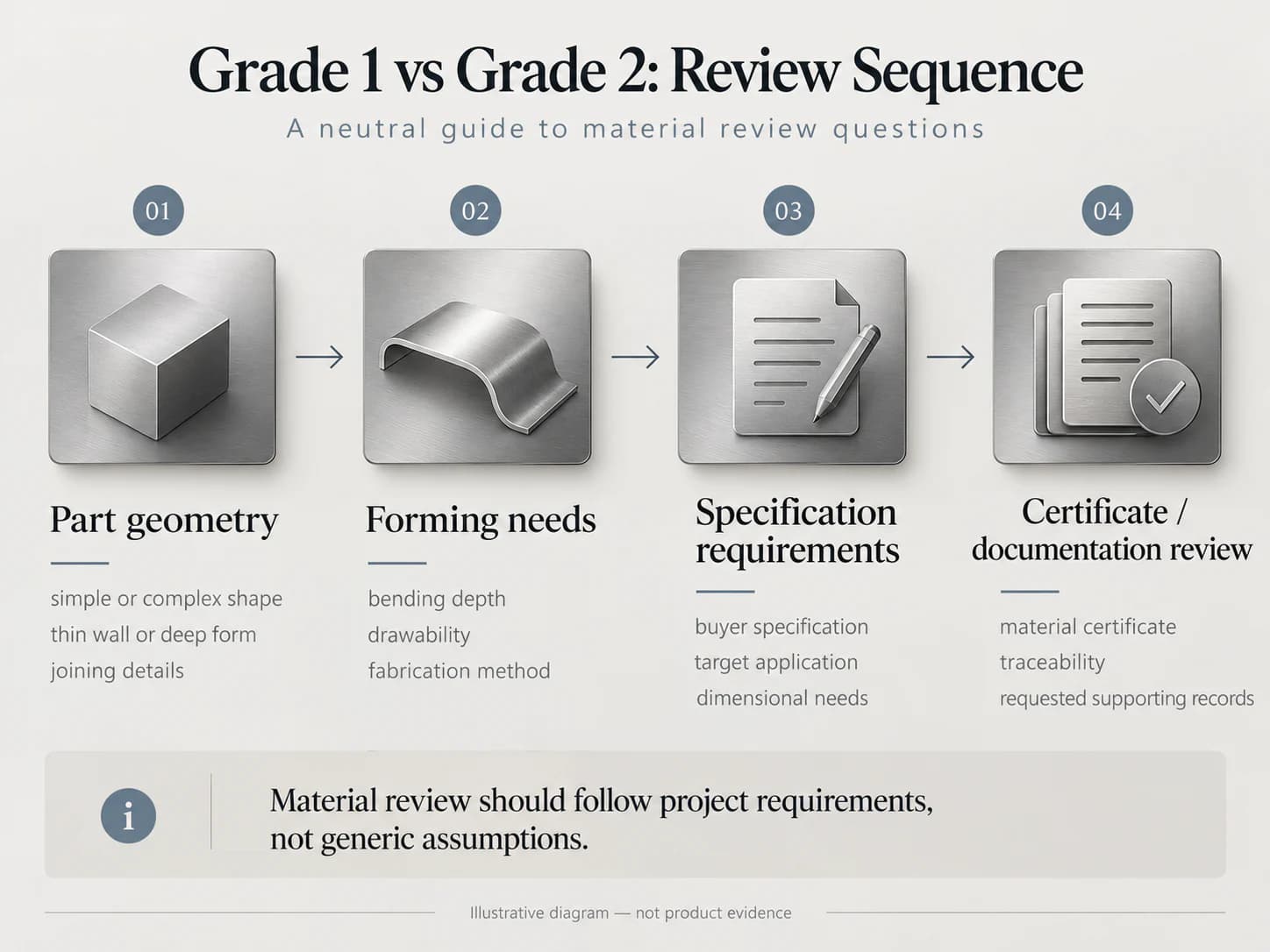
Key takeaways
- Grade labels describe material specifications; they do not by themselves approve a finished product.
- Grade 1 and Grade 2 are both commercially pure titanium grades, but their mechanical balance differs.
- A product image or general supplier statement cannot replace a material certificate and configuration-specific specification.
- 7Titanium does not assign a grade to a public product platform unless that configuration is verified.
What the grade labels mean
Commercially pure titanium is supplied in several grades. ATI’s technical data sheet describes the grade family as combining ductility, corrosion-resistance context, moderate strength and weldability; differences between grades are associated with oxygen level. A grade is therefore a material designation, not a statement about a complete cookware, bottle or tableware product.
For a buyer, the useful question is not simply which grade is ‘best’. It is whether the proposed material specification fits the part geometry, forming steps, joining method, finish, performance requirements and target-market documentation for the specific configuration.
Source basis: ATI CP Grade 1–4 Technical Data Sheet (see References).
Practical comparison for product review
Grade 1 is commonly considered when additional formability is valuable. Grade 2 is commonly considered when a higher-strength balance is needed. Those are starting points for engineering review, not a substitute for a drawing, sample or agreed specification.
| Decision area | Grade 1 context | Grade 2 context | Buyer implication |
|---|---|---|---|
| Forming | Greater formability is often considered | Formability must be assessed against the part | Review deep draws, bends and thin features with the actual geometry. |
| Strength | Lower-strength balance within the CP family | Higher-strength balance within the CP family | Do not infer finished-product performance from grade alone. |
| Documentation | Certificate and material condition still matter | Certificate and material condition still matter | Request the specification and traceable material record for the selected configuration. |
What to request before finalizing material
Ask for the intended grade or material specification, product configuration, material certificate where required, forming and joining considerations, finish requirements, and any target-market documentation. If the project changes wall geometry, coating, assembly or intended use, recheck whether the original evidence still applies.
This article is general education. It does not state that any 7Titanium cookware, drinkware or tableware platform uses Grade 1 or Grade 2.
Questions buyers often ask
Is Grade 2 always better than Grade 1?
No. The appropriate choice depends on the full product and manufacturing brief, not on a universal ranking.
Does a titanium label prove the grade?
No. Confirm the agreed material specification and, where needed, a traceable certificate for the actual configuration.
Can a product image confirm material grade?
No. Images can show appearance, but they do not establish grade, chemistry or certificate scope.
Scope and evidence boundary
This article is educational. Product-specific material, finish, documentation, testing and compliance statements must be verified against the selected configuration and applicable market requirements.
References
- ATI CP Grade 1, CP Grade 2, CP Grade 3, CP Grade 4 Technical Data SheetATI · Commercially pure titanium grades, ductility, strength and fabrication context.
Have a configuration to review?
Share the product brief, target market and documentation question for a project-specific conversation.
Start your project