
Product development / review stages
From Titanium Product Concept to Prototype and Production Review
A stage-by-stage guide to moving a titanium product brief from requirement through CAD review, prototype and production decisions.
Direct answer
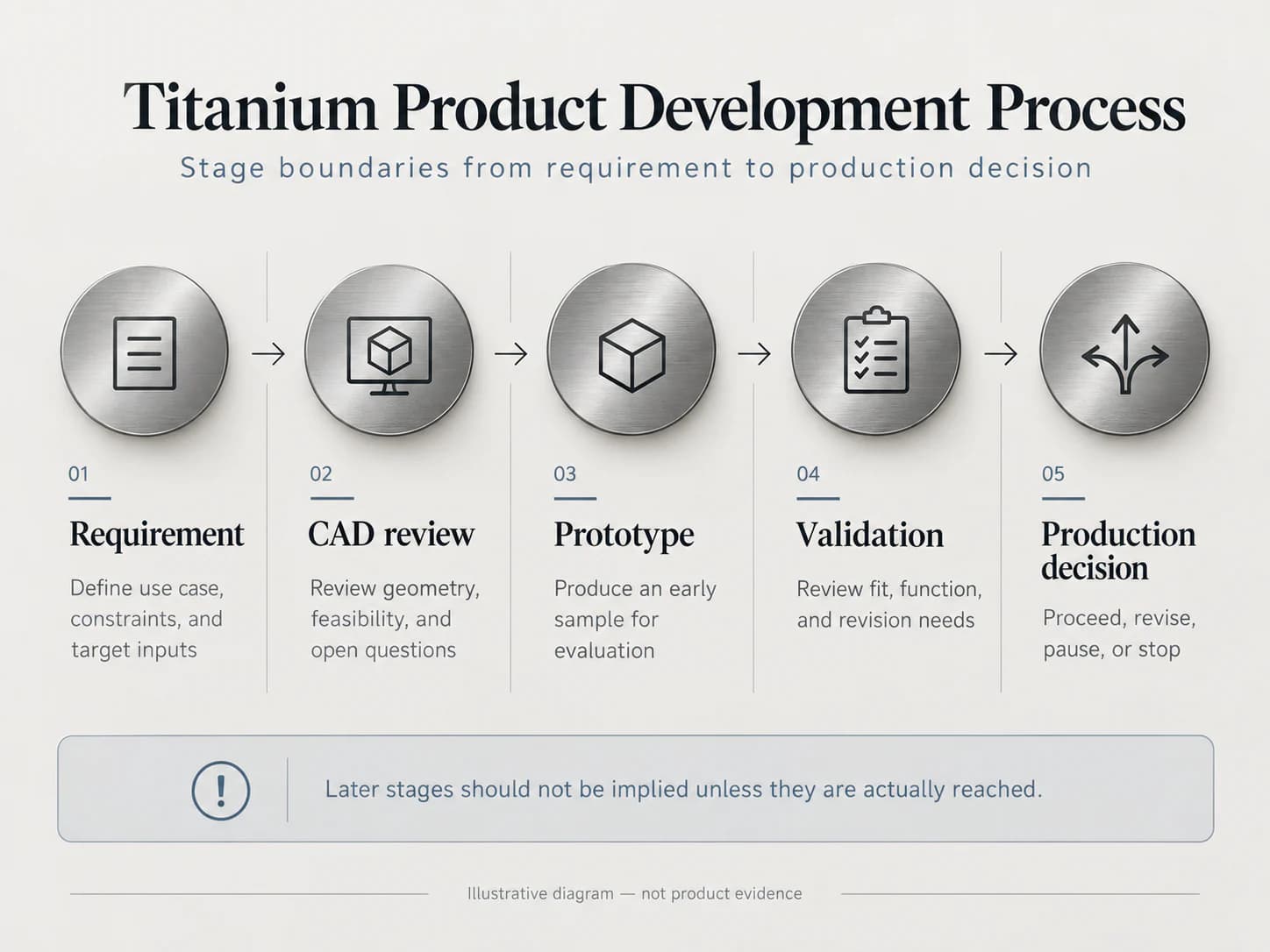
A titanium product project normally becomes clearer through defined stages: requirement, CAD review, prototype, validation and a separate production decision. Each stage reduces a different uncertainty; reaching one stage does not prove that later stages are complete.
Key takeaways
- A drawing, sample or written brief establishes an input—not a finished specification.
- CAD review identifies questions in geometry, dimensions, structure and manufacturability.
- Prototype and validation are separate from production approval.
- The Honey Stirring Stick public project is currently in CAD review; prototype is pending and production is not confirmed.
A decision-led sequence
Requirement defines the intended product, market, use, constraints and available references. CAD review then examines geometry, dimensions, interfaces and questions that need resolution before a physical sample route is chosen. The output should be clearer decisions and open items, rather than an implied production commitment.
| Stage | Purpose | What it does not prove |
|---|---|---|
| Requirement | Capture product inputs and decision criteria | Final feasibility or certification. |
| CAD review | Review geometry, dimensions, structure and open questions | A completed prototype or production route. |
| Prototype | Create or review a physical sample when ready | Validation or repeat production approval. |
| Validation | Evaluate the agreed sample criteria | Automatic production approval. |
| Production | Begin only after explicit approval | That every future variant shares the same evidence. |
Use project examples with bounded status
7Titanium’s Honey Stirring Stick Development page is a bounded public example. Its recorded status is CAD review; prototype is pending and production is not confirmed. It is useful for showing the distinction between supplied 3D input and a completed production case, not as proof of a validated result.
A buyer can speed an initial review by supplying the most current drawing or 3D data, target dimensions, material expectation, finish, function, critical features, target market and documentation needs.
What changes after a prototype
The prototype phase should establish which questions the physical sample must answer. Validation criteria, revisions, documentation and next decision should be explicit. Production is a separate decision made only after the relevant requirements and approvals are resolved.
Questions buyers often ask
Does CAD review mean a product is ready for production?
No. CAD review is an early decision stage; prototype, validation and explicit production approval may still be required.
What should a buyer send first?
A drawing, STEP/3D file, reference sample or clear written brief can establish the first review inputs.
Is the Honey Stirring Stick a completed case study?
No. Its public status is CAD review, with prototype pending and production not confirmed.
Scope and evidence boundary
This article is educational. Product-specific material, finish, documentation, testing and compliance statements must be verified against the selected configuration and applicable market requirements.
References
- Honey Stirring Stick Development7Titanium · Public project-stage record; CAD review only.
Have a configuration to review?
Share the product brief, target market and documentation question for a project-specific conversation.
Start your project